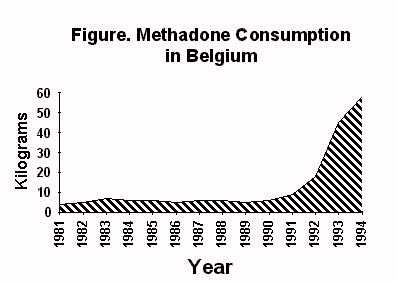
SUMMARYMethadone prescribing increased tenfold in the last four years in Belgium. This has been made possible through involvement of general practitioners in methadone treatment. Drug overdoses, crime and even presence of methadone on the black market have decreased at the same time. Introduction During the last four years, methadone consumption in Belgium increased tenfold (From 6 kg/year in 1990 to 58 kg/year in 1994). This fact may seem insignificant because it concerns a country with a population no higher than that of New York City and whose precise geographic location may not be known to everyone. However the Belgian experience might demonstrate that it is possible to overcome certain limitations of methadone treatment as it is generally practiced. Legal Confrontation Methadone has been available with a prescription in pharmacies since the 1970’s. But physicians who began to prescribe it to addicts at the beginning of the 1980’s, when the heroin epidemic was worsening, were often subjected to disciplinary sanctions by the Belgian Medical Association and sentenced by courts of justice. At the beginning of the 1990’s a group of physicians, including myself, requested that the Supreme Court revoke the Medical Association’s regulations permitting the indictment of physicians prescribing methadone and other substitution treatments. This request was granted. Subsequently, the regional authorities of the French speaking part of Belgium began to encourage physicians to treat opiate addicts with methadone. The authorities became aware of drug addiction’s impact on criminality and on the AIDS epidemic. They knew that it would be impossible to extend rapidly the number of methadone clinics and they also wanted to avoid stigmatizing heroin addicts. To encourage the treatment of addicts in normal settings, they allocated funds for training sessions for general practitioners on treatment of drug addiction. Consensus Conference Another measure which permitted a rapid expansion of methadone treatment was the organization of a Consensus Conference on Methadone Treatment by our Minister of Health. The conclusions of the Consensus Conference were sent to every doctor in the country, as new guidelines for methadone treatment. They stated the following points:
These conclusions are in no way revolutionary on the scientific level, but as official guidelines for methadone treatment, they represent a significant innovation, compared to what happens in a lot of countries. Methadone is now dealt with as an ordinary medication. Its effectiveness is recognized without ambiguity. No longer is it considered an experimental treatment, accessible only to a limited number of patients and subject to rigid controls. No longer are patients required to have attempted previous withdrawal treatments. Addiction can be ascertained by spontaneous withdrawal attempts recounted during patients history. Urinalysis is done only following doctor’s decision. It is specified in our new guidelines that dosage and duration of treatment should not be limited, but adapted to each patient by the physician. It is acknowledged that short-term methadone treatment are appropriate only in certain very particular cases. Daily administration of methadone is not compulsory, but recommended at the beginning of treatment and will generally take place in a pharmacy chosen by the patient. The physician is free to prescribe larger quantities of methadone at less frequent intervals, depending on how the patient evolves. Conclusion The number of heroin addicts undergoing methadone treatment is increasing and now reaches 5.000, out of an estimated total number of heroin users of 20.000 to 30.000. More than 80% of these patients are being treated by general practitioners. Hundred of general practitioners are currently involved in methadone treatment. Most patients receive methadone provision for one or two weeks, but the presence of methadone on the black market has decreased, since less addicts are seeking methadone on the streets. Drug overdoses and criminality have decreased. Thus the very flexible method of prescribing methadone used today in Belgium seems to have resolved some problems and does not seem to have created any. Marc REISINGER Vanne Notes |